

Anonymised ITFR client case study. The client name, locations and identifying details have been changed for confidentiality.
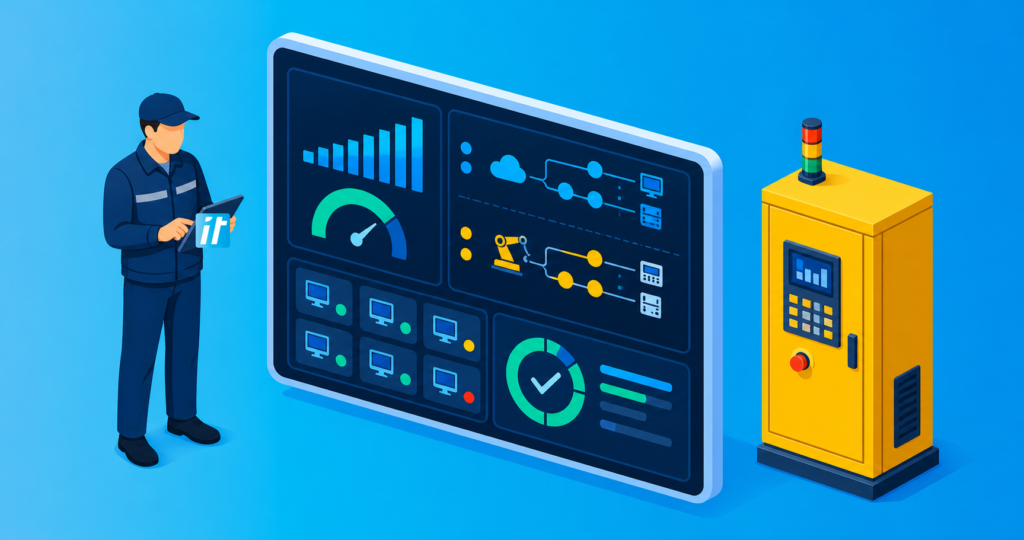
An Australian manufacturer engaged ITFR to improve security across its head office, warehouse and production environment. Office systems used modern cloud services, but shared production terminals, legacy applications and inconsistent administrative access created gaps. Leadership wanted measurable improvement without interrupting production.
Start with dependencies, not a blanket security policy
We documented critical production workflows, suppliers, remote-support paths, recovery time expectations and the devices that could not be patched on the same cycle as office laptops. This separated genuine operational constraints from settings that had simply never been revisited.
The assessment also identified shared administrator accounts, backups that had not been restored recently and internet access from systems that did not need it.

A CIS Controls roadmap proportionate to the environment
We used CIS Controls and practical security best practice to organise the uplift around asset visibility, identity, vulnerability management, secure configuration, recovery and incident response. The target was a defensible, staged improvement program rather than a rushed claim of certification.
Office identities received stronger multi-factor authentication and separate administration. Patch and application-control pilots started with representative devices. Production networks and vendor access were segmented, logged and restricted according to operational need.
How the ITFR security stack was implemented
We deployed the ITFR managed endpoint stack for device inventory, endpoint protection, monitoring and controlled patching. Identity controls separated daily and administrative accounts, strengthened multi-factor authentication and reduced standing privilege. Network changes isolated production dependencies, while backup monitoring and scheduled restore tests improved recovery confidence.
Implementation methodology
- Create an asset and dependency register covering office endpoints, production terminals, legacy applications, network paths and vendor support connections.
- Define test, early-adopter and production deployment rings with maintenance windows, success checks and documented rollback steps.
- Deploy endpoint monitoring and protection first for visibility, then introduce controlled patch policies based on device role and production tolerance.
- Separate daily and administrative identities, strengthen multi-factor authentication and restrict vendor access to named, approved and time-limited sessions.
- Segment production dependencies from general office traffic and log the pathways still required for operational support.
- Separate backup administration, monitor job results and prove recovery through sample restores and a business-led incident tabletop exercise.
Operators received short explanations about what would change on their device and what to do if a process behaved unexpectedly. This improved accountability without preventing urgent support.


Recovery became a demonstrated capability
Backups were separated from normal administration, protected with stronger identity controls and tested against realistic restore scenarios. The business ran a tabletop exercise covering a compromised office account, an unavailable file service and a production-support decision.
The uplift reduced standing privilege, improved device visibility and gave leadership a prioritised backlog tied to business risk. Most importantly, the organisation could show how it would keep making and shipping products while containing a cyber incident.